

A qualified powder booth contains an extractor fan accurately calculated for optimal cross-section wind speeds (typically 100-120 ft/min), grounding equipment, and an efficient recovery unit. It will control overspray, protect operators and recover unattached powder.
Note, install the explosion-proof fan, and when your spray booth is integrated with the dedicated compressed air cold dryer, electrostatic spray gun and curing furnace, remember to ground the entire structure.
what is a powder coating system?
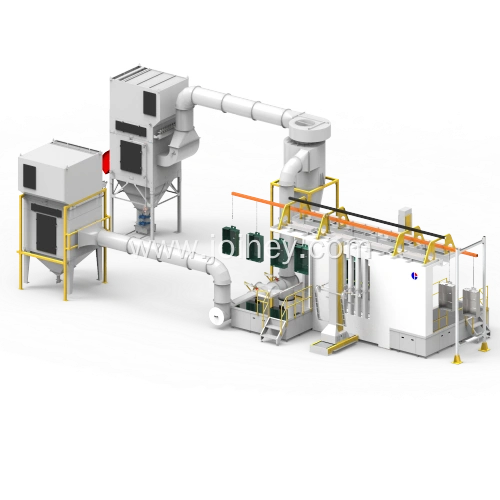
The powder coating system is an integrated mechanical and electrostatic circulation loop designed to apply dry powder to a grounded substrate and efficiently recover any wasted material. It goes far beyond simple airbrushes and exhaust fans. Industrial-grade equipment utilizes automated assembly lines, precisely positioned reciprocating machines, and multi-stage air filtration to maintain continuous production cycles.
what equipment is needed for powder coating?
You need specific industrial hardware to build a viable production line. Reliance on improvised pieces of parts leads to unsafe levels of flammable dust concentration and ruins the coating surface quality.
- Spray booth housing: Polypropylene or anti-static stainless steel panel to prevent powder from adhering to the wall.
- Suspended conveying system: Grounded track that transports workpieces through the spraying area at a controlled speed.
- Electrostatic spray gun and reciprocating machine: A robotic arm that automatically sprays powder with consistent coating thickness.
- Extraction and filtration unit: Precisely sized exhaust fan that extracts air evenly across all openings in the spray booth.
- Powder recovery system: Cyclone separator with rear filter element for capturing and reusing sprayed powder.
Step 1: Build a closed and controlled spray booth structure
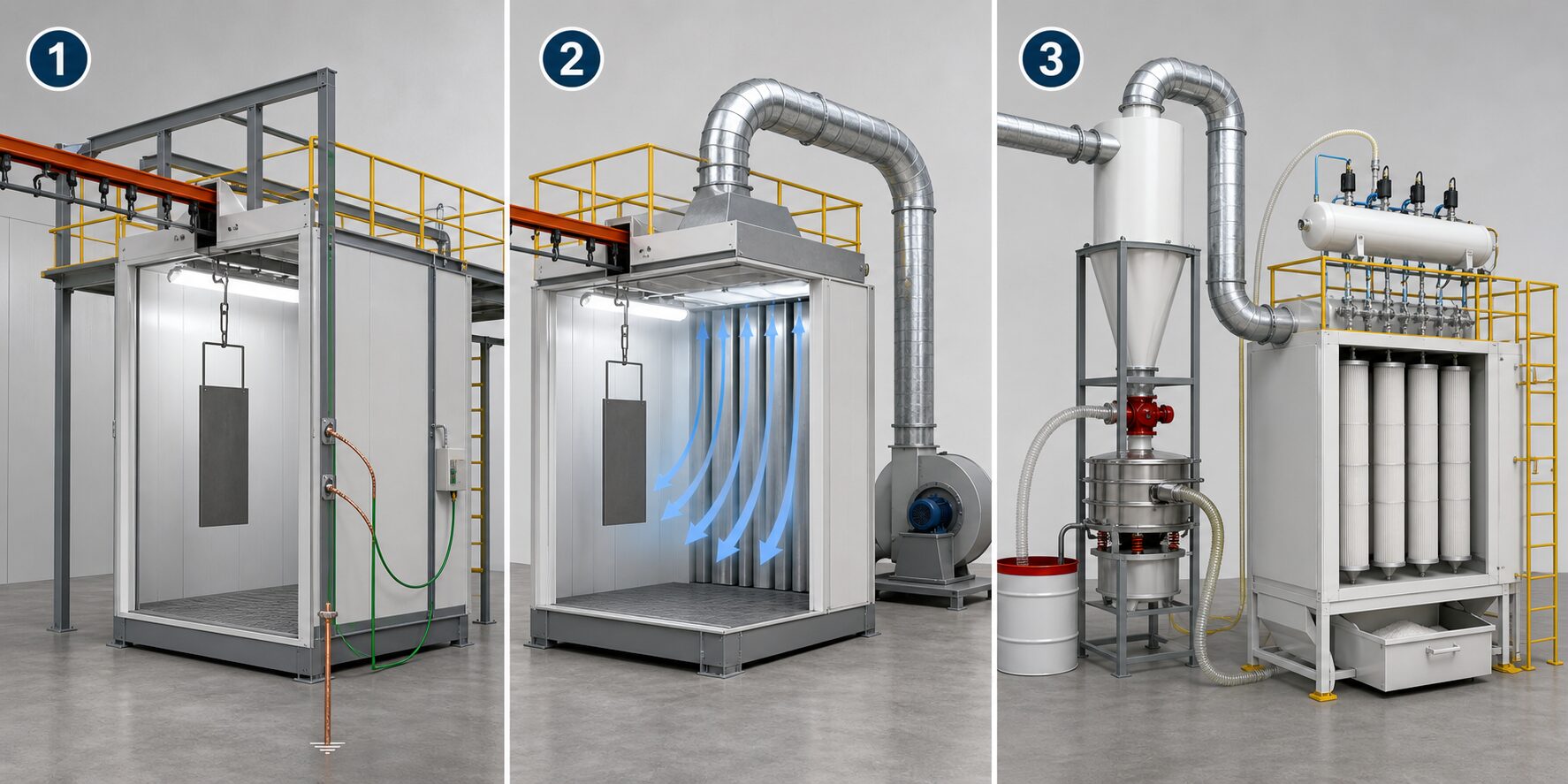
The geometry of the spray chamber directly determines the surface coating quality. A poorly shaped enclosure creates turbulence in the airflow.
Specific construction and grounding steps of the closed control link
The spray booth housing is assembled to create an electrostatic isolation zone that is free of dead spots and fully grounded.
1.1 Building the external load-bearing frame and inner wall panels
Never expose the structural skeleton inside the spray booth, as this will create a powder accumulation platform that is extremely difficult to clean. A strong external load-bearing frame must first be welded using carbon steel square tubing (recommended gauge is four by four inches).
After the skeleton is completed, a polypropylene panel or an anti-static stainless steel plate is fixed to the inner side of the skeleton. The panel-to-panel seams must be secured with flat-head countersunk screws and sealed with anti-static silicone, ensuring the entire spray booth interior is mirror-flat without any protruding flanges or bolt heads.
1.2 Precisely cut openings and control electrostatic spacing
Cut a through slot in the top of the spray house, depending on your hanging conveyor track. Calculating the distance from the spray gun to the nearest spray chamber wall, a radius clearance of at least thirty-six inches (about one meter) must be strictly maintained. If the gap is too small, the high-voltage static electricity from the spray gun will occur “Faraday cage effect”, adsorbing the powder directly onto the wall instead of the workpiece you are spraying.
1.3 Build an independent grounding network
Never use conventional grounding wires from factory buildings. A special pure copper ground rod at least eight feet deep must be driven into the concrete floor next to the spray house. This ground bar is hard-wired with bare copper braided wire to the steel track of the suspended conveyor, the workpiece hangers, and the metal parts of the spray booth (if stainless steel walls are used). After construction is completed, the resistance value between the workpiece and the ground wire must be less than one megohm using a megohmeter test.
Step 2: Fluid Mechanics Configuration of Airflow Management
Don’t just buy an exhaust fan and install it. You have to design the static pressure box and the exhaust duct according to fluid mechanics standards.
2.1 Calculate the absolute exhaust volume and select the fan
Measure all the opening areas of the spray booth that are connected to the outside world. Suppose you have two doors for the operator to spray (three by seven feet each), plus the conveyor opening at the top, for a total open area of fifty square feet. To achieve the industry standard of one hundred and twenty feet per minute of cross-sectional wind speed, the formula is: fifty times one hundred and twenty, which equals six thousand cubic feet per minute.
When purchasing a fan, you must choose a backward-tilting centrifugal fan and absolutely do not use an axial flow fan. Because the powder filtration system will produce extremely high static pressure resistance, only the centrifugal fan can maintain a stable air extraction volume even when the filter element is gradually blocked.
2.2 Post-assembly static pressure box and slotted deflector
A static pressure extraction box of equal height and width to the spray booth is constructed directly behind the spray booth. The key operation is at the junction of the spray booth and the static pressure box: do not leave a huge hole for the exhaust. You have to install a row of slotted deflectors with vertical slits. The narrow top slit and wide bottom slit force the powerful air flow to sweep evenly from top to bottom across the entire work area, completely eliminating the dead-angle powder gathering problem in the four corners of the spray booth.
Step 3: Automatically switch the pipeline connection and integration of the powder recovery system
This step is at the heart of achieving a rapid fifteen-minute color change. You need to seamlessly connect the spray booth vents on the front end to the dual-stage recovery equipment on the back end.
3.1 Use a round tube to connect the cyclone separator
Exhaust duct leads from the top of the static pressure box of the spray booth, connecting it directly to the side air inlet of the large cyclone separator. This connecting pipe must use a round pipe with an extremely smooth interior. Square pipes are strictly prohibited. The ninety-degree inner angle of square pipes will quickly accumulate powder, which can easily fall off during color change and cause serious cross-contamination. The elbows of all pipes must be smooth transition elbows of large radius.
3.2 Establishment of a physical circuit for powder reflux at the bottom
At the bottom discharge port of the cyclone separator, a rotary discharge valve is connected through a flange. The valve allows the system to remain airtight while allowing the falling usable powder to be discharged evenly. A circular ultrasonic vibrating screen is installed directly below the discharge valve to filter out impurities or lumps that may be mixed into the powder. Finally, the sieved pure powder is pumped directly back to the main powder supply barrel through the antistatic powder tube through a venturi powder pump or peristaltic pump to form a closed loop.
3.3 Connecting the secondary filter cartridge to the configuration pulse backblow
The exhaust port at the top of the cyclone separator discharges a high-speed air flow containing extremely fine waste dust. This exhaust port is piped into the secondary filter cartridge collection box. Install the laminated filter elements side by side in this collection box. At this stage, a gas tank and a pulse backblow solenoid valve must be installed directly above each filter element. Set the solenoid valve to spray high-pressure air into the inside of the filter element every thirty seconds to shock the waste dust attached to the outside of the filter element into the garbage drawer at the bottom. This guarantees that your main exhaust fan will never lose suction due to a clogged filter.
How do you measure powder coating shop efficiency?
Successful spray booth construction relies on the CFR efficiency pyramid: containment control, airflow management, and powder recovery. You have to master each layer in turn. Failure of the bottom layer containment control is bound to lead to failure of the top layer powder recovery.
Efficiency is not measured by how many workpieces leave the oven each day, but by powder utilization and reduced downtime.
Track your system’s transmission efficiency. To calculate this metric, record the exact weight of powder ejected from the lance and compare it to the weight of permanently cured powder on the workpiece. Optimized spray booths equipped with high-end cyclone recovery systems should maintain 95% or higher system transmission efficiency.
FAQ About Powder Coating Spray Booth
Q: What is a powder coating system?
A: An integrated industrial assembly line that uses static electricity to evenly apply dry powder to grounded workpieces, cures at high temperatures to form a durable coating, and relies on an automatic recovery unit to collect overspray powder for recycling.
Q: What equipment is needed for powder coating?
A: Core equipment includes: surface pre-treatment cleaning line, anti-static powder booth shell, electrostatic spray gun and automatic reciprocating machine, powder curing oven, and powder recovery system including cyclone separator and secondary filter element.
Q: How much does a powder coating system cost?
A: Costs vary by size. Entry-level commercial manual systems typically cost between $10,000 and $50,000, while industrial-grade production lines equipped with automatic switching recovery systems, reciprocating machines, and fully automated conveyor lines typically cost more than $100,000 to $500,000.
Q: How do you measure powder coating shop efficiency?
A: Mainly through two indicators: one is the system transmission efficiency (the weight ratio of the powder actually solidified on the workpiece to the total ejected powder should reach more than 95%); the other is the color change downtime (an excellent cyclone system can compress it to within 15 minutes).
Q: Does the powder booth need fresh air?
A: Need. If you’re venting 5,000 cubic feet per minute of air from the shop outward, you’ll have to introduce an equal amount of fresh, temperature-controlled make-up air. Negative pressure in the workshop can cause dust contamination and trigger air flow disturbances in the spray booth
Q: How often should the filter element in the powder coating booth be replaced?
A: In systems without cyclones, the primary filter element needs to be replaced every 6 to 12 months, depending on how often it is used. In cyclone systems, the final rear filter cartridges last 2 to 3 years because they only need to handle very small amounts of fine dust.