

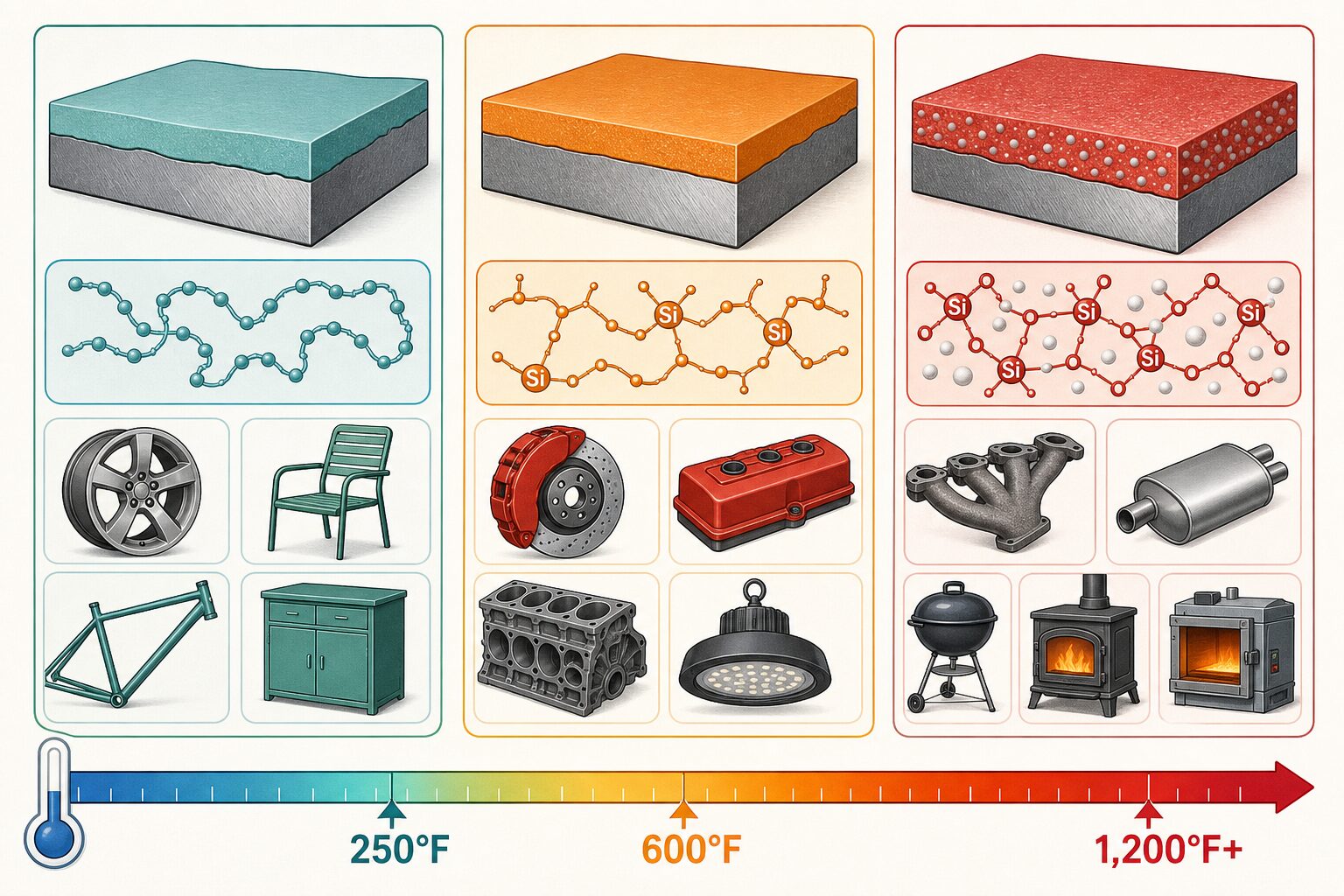
Standard powder coating vs. High temperature powder coating
In order to choose the right surface treatment for your metalworking project, you need to understand the thermal limits of different powders in the metal surface treatment industry.
Standard powder coating (up to 250°F)
Standard thermosetting powders are the industry standard for everyday metal products. They are extremely resistant to UV rays, chemicals, and physical shock, but their organic polymers (such as epoxy and TGIC polyester) are not designed for extreme heat.
- Temperature limit: Can withstand environments up to 250 °F (121°C) continuous. It may be possible to withstand short temperature peaks of up to 300 °F (149° C), but this is not recommended.
- Common Applications: Aluminum alloy wheels, suspension parts, interior cabinets, patio furniture and bicycle frames.
Heat resistant coating in the middle section (up to 600 °F
Manufacturers use specialized silicon-modified powders when the application scenario exceeds 250°F but does not face direct combustion or open flames.
- Temperature limit: Continuously subjected to temperatures between 300°F and 600°F(149°C and 315°C).
- Common Applications: Brake calipers, engine valve compartment covers, engine blocks, and commercial lighting fixtures.
Extreme High Temperature Powder Coating (Up to 1,200 °F+
This type of powder is designed for the harshest environments and is highly dependent on inorganic silicone resins and ceramic microparticles. Because they contain no organic compounds that can be burned, they offer unparalleled thermal stability.
- Temperature limit: Can withstand extreme heat from 600°F to 1,200°F and even higher (315°C to 650°C+).
- Common Applications: Exhaust manifolds, exhaust head sections, silencers, grills, wood-burning stoves, and industrial furnaces.
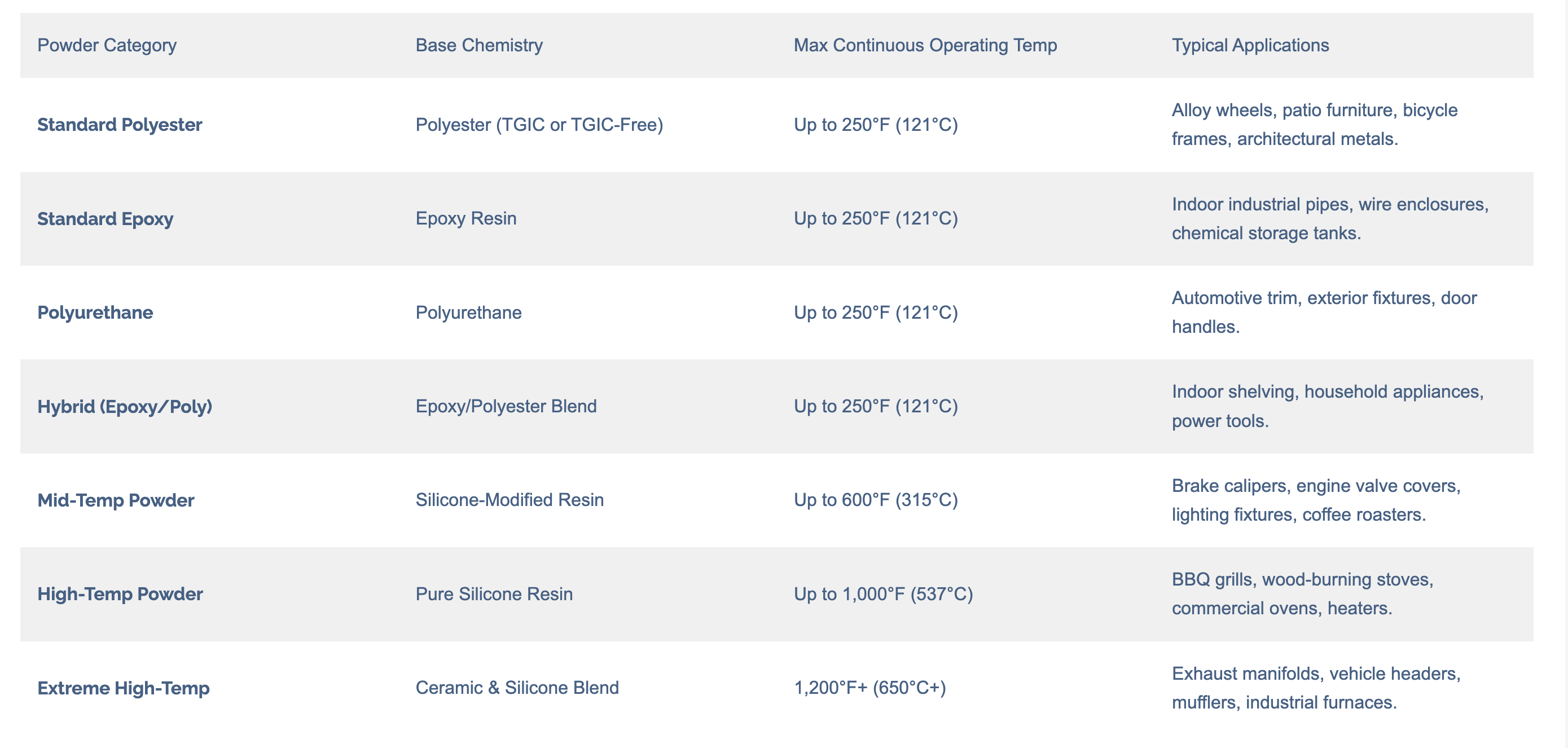
Powder Coating Types and Maximum Temperature Limits
Difference between curing temperature and working temperature
In the powder coating world, one of the most common questions customers have is: “If my powder coating is baked in a 400°F oven, why can’t it withstand 400°F in real life?”
The answer lies in the chemistry of the curing process. When the raw powder is coated on a bare metal substrate, it must be placed in a curing oven (usually baked at 400°F for 15-20 minutes). This high temperature melts, levels and chemically cross-links the powder to form a strong and durable protective shell.
However, once this chemical reaction is complete, the structure of the coating is permanently fixed. If you reheat that standard part that has already been painted to 400°F in practice, the cross-links inside it will break, causing the coating to fail directly. In short, the curing temperature is a one-time baking condition and is by no means an indicator of the long-term heat resistance of the coating.
How hot to cure powder coat
So, just how high does it take to perfectly cure a powder coat? For the vast majority of standard powder coatings, the ideal cure temperature is typically between 350 °F and 400° F (175° C and 204° C) and requires constant constant temperature for 10 to 20 minutes.
It is worth noting that the temperature here refers to the part metal temperature, that is, the metal substrate itself must reach this heat, not just the air temperature inside the oven. If the substrate is very heavy, it will take longer to fully warm up. In addition, certain specially formulated low temperature cured powders can complete crosslinking at around 250°F, while some extreme ceramic high temperature powders may require higher initial baking heat. Strict adherence to the curing heat recommended by the manufacturer is an absolute prerequisite for ensuring that the coating is thoroughly cross-linked and reaches its maximum heat resistance limit.
What happens when powder coating overheats?
Incorrect application of standard powder coatings to high-temperature components such as exhaust pipes or grill smokers can lead to rapid and noticeable coating failure. Here are the chain reactions that occur when you break your thermal limit:
- Tarnish and discoloration: The first signs of thermal damage are visual. A high-gloss surface can quickly become dull and dull. Light colors (especially white and bright yellow) can be scorched by the heat, permanently turning an unsightly yellow or brown.
- Softening and foaming: Standard polyester and epoxy powders soften when temperatures climb above 300 °F(149°C). If the temperature continues to rise to 500 °F(260°C), the coating will even simply remelt and flow.
- Cracking, peeling and rusting: Extreme high temperatures can completely destroy the adhesion of the coating to the metal substrate. The coating becomes brittle, cracks and peels off in flakes, leaving the underlying steel or aluminum completely exposed to air and moisture, leading to irreversible rapid oxidation and rusting.
How to touch up powder coated metal
Whether it’s cracking and peeling of the coating due to exceeding the thermal limit, or physical scratches from daily assembly and use, you need to master the appropriate local repair techniques. Because re-powdered painting requires the use of an electrostatic spray gun and a high-temperature oven again, which is extremely unrealistic with parts already installed, spot repairs often rely on color-matched, specialized liquid repair paints.
Steps to Repair Damaged Powder Coated Metal:
- Air Dry and Cure: Follow the refinish instructions exactly and allow it to air dry completely naturally. For some high temperature refinish paints, thermal curing may also be required by the heat generated by running the engine.
- Clean the surface thoroughly: Wipe the damaged area with a mild degreaser or isopropyl alcohol. It is essential to ensure that the peeling area is free of any oil, dust or exposed rust, otherwise the new paint will not adhere.
- Lightly Sand Edges: Use fine sandpaper (such as around 400 grit) to lightly sand the edges of the damaged area. This step removes loose residual coating and smoothes the transition between the old coating and the bare metal, increasing the mechanical adhesion of the refinish paint.
- Apply touch-up paint: Apply a matching liquid touch-up paint evenly using a fine-bristled brush or spray, depending on the size of the scratch or shed area. A very critical point is: If your metal parts are working at high temperatures (such as engine parts or exhaust pipes), be sure to repair them with a special high-temperature resistant automotive paint or ceramic paint; if you use regular repair paint, it will quickly blister and burn out again at high temperatures.
Choosing the right powder for different temperature applications
It can be seen that the standard powder coating is exceptionally durable, but can only withstand operating temperatures of up to 250 °F (121°C). If your project involves an engine, exhaust system or heating appliances, you must decisively upgrade to use high-temperature powder coating, which can safely protect your metal parts in harsh environments up to 1,200 °F+ (650 °C+). By matching the right chemical formula to the heat exposure environment your part is expected to experience, you’re guaranteed to get a flawless, corrosion-resistant, and time-tested coating.
Frequently Asked Questions About Powder Coating
1. can powder coating withstand heat
Yes. Standard powder coat safely handles up to 250°F (121°C). For extreme parts like exhausts, specialized high-temp powders are used, which can withstand heat up to 1,200°F+ (650°C+).
2. does powder coated steel get hot in the sun
Yes. Powder-coated steel absorbs heat in direct sunlight, especially dark colors. However, this solar heat is far below its 250°F limit and will absolutely not melt or damage the finish.
3. how hot to cure powder coat
Most standard powder coats cure at 350°F to 400°F (175°C to 204°C) for 10-20 minutes. Note that this target temperature must be reached by the metal substrate itself, not just the oven air.
4. how to clean powder coated metal
Clean the surface using warm water, mild dish soap, and a soft microfiber cloth. Avoid harsh chemicals, acetone, or abrasive scrubbers, which can permanently scratch or dull the finish.
What Temperature Can Powder Coat Withstand-Plus Powder Form